

Scope of services
All license models, with the exception of the Free License (restriction on exports), offer the full range of functions and differ only in the number of available projects and user accounts.
LOIN (Level of Information Need)
BIMQ ensures the creation and management of the level of information needs in accordance with the DIN EN 17412 (LOIN) and supports this with various functionalities. Different areas are available in BIMQ for this purpose, which are described in detail in the “Workflow” section.
The concept of LOIN describes the required level of detail in BIM projects and ensures that the right information is available at the right time and with the right level of detail.
Figure: LOIN
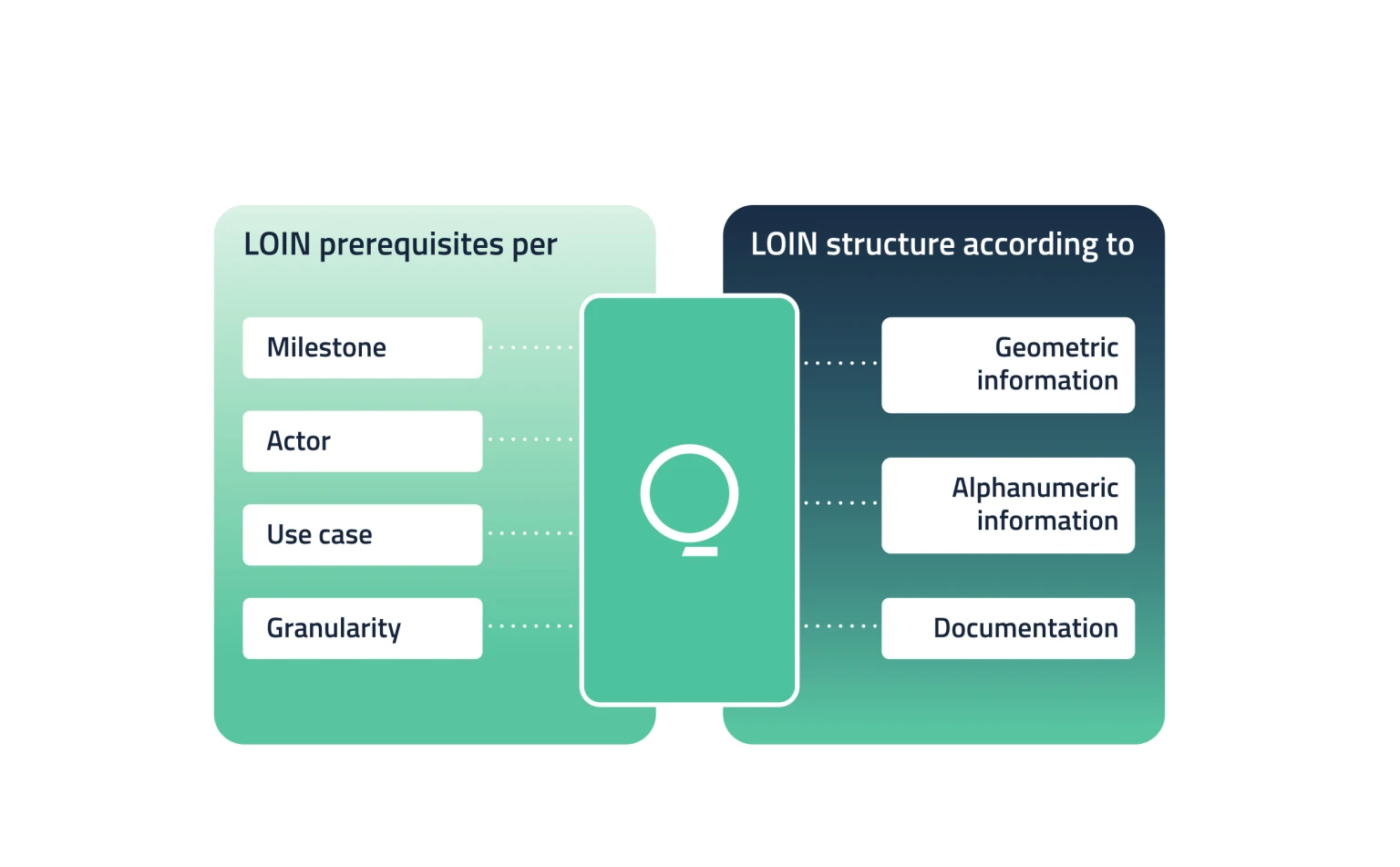 In addition to the geometric and alphanumeric information content, the LOIN standard also defines the exact exact prerequisites:
When is the information needed? (Milestone)
Who needs the information? (Actor)
What is the information needed for? (Use case)
What information is needed? (Granularity)
Information management with BIMQ
With BIMQ, LOINs can be created and managed in the cloud on a role-based basis and connected to different source and target systems. The scope of services can be divided into three basic areas:
Figure: Scope of services
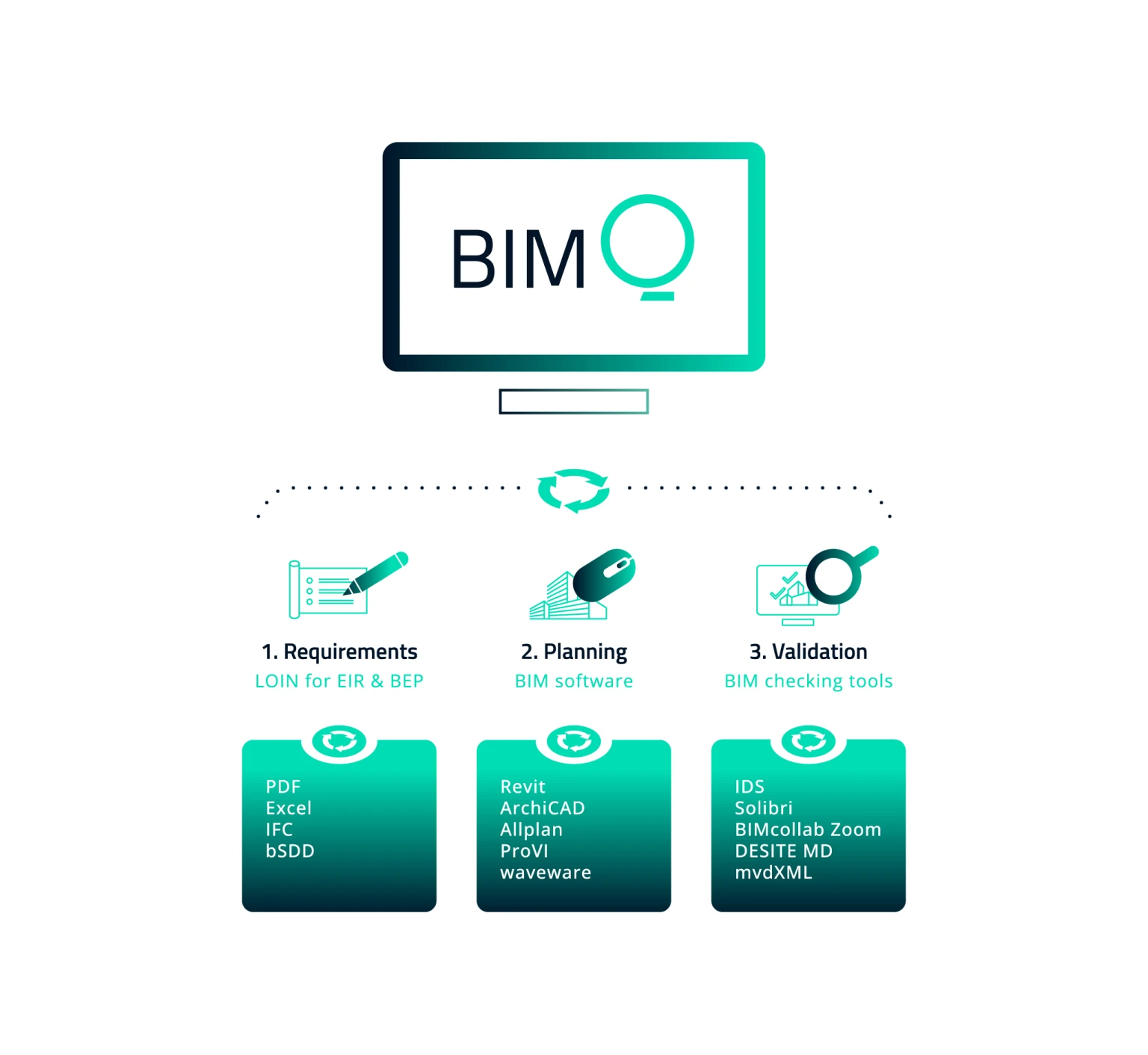
Requirements:
Create and manage information requests based on your own or provided catalogs for all project participants. With access to external content such as various master catalogs, IFC mapping definitions, classification systems, etc., information requests can be generated in a standardized and consistent manner. Detailed LOIN reports, attachments for EIR/BEP, or element/attribute tables can be provided and shared as PDF, Excel, or directly online via BIMQ.
Planning:
BIMQ enables information requests to be transferred to various BIM software systems. These are provided in the form of attribute templates, with all data types, units, descriptions, selection fields, and element links, and can be digitally transferred to the respective BIM software. BIMQ also provides the necessary configuration files for IFC export.
Validation:
With BIMQ, the checking rules for quality control can be exported automatically. This allows IFC models to be checked specifically for the required information content—tailored to the respective project phase, the defined use case, and the specific requirements of each planning discipline.
Master catalogues
Every BIMQ customer has access to the publicly available master catalogs and is authorized to use the content available there. All master catalogs can also be used as project templates. The following master catalogs are available:
C1 – Information requirement catalogue for building construction projects (Germany)
C2 – Information requirement catalogue for building construction projects (Austria)
C3 – Information requirement catalogue for building construction projects (Switzerland)
C4 – IFC elements and properties according to buildingSMART
C5 – Semantic object model of Deutsche Bahn
C6 – BIMids – Exchange Requirements from Luxembourg/Belgium
C7 – VIB_FireSafetyRequirement
The AEC3 team is committed to making catalog content from buildingSMART International, the various national chapters or national specialist groups, and other groups publicly available.